
Full Spectrum LED Grow Light Strip Project for Microgreens in Fiji: From Small-Scale Testing to a Scalable Grow Rack Lighting Setup
By Shirley Huang | Updated:Oct 7, 2026
Lighting for microgreens is not simply about making a grow rack bright enough.
Spectrum, strip power, mounting distance, rack dimensions, power supply configuration, and future expansion can all affect how a growing-light system should be designed.

In 2023, a customer from Fiji contacted us while looking for a full spectrum LED grow light strip solution for his microgreens racks.
He was not planning to equip every rack at once.
His idea was much more practical: build a small system first, test it under real growing conditions, and then expand if the setup worked well.
That approach gradually turned what began as a search for LED strip lights for growing plants into a more complete lighting project involving spectrum comparison, modular strip lengths, power matching, and future rack expansion.
Project Background: Planning a Multi-Level Microgreens Grow Rack System
The customer was already growing microgreens with plant lights and wanted to rebuild his setup around multi-level growing racks.
The initial rack information he shared with us was approximately:
• 0.5 m wide
• 1 m long
• 4 shelves per rack
• possible future expansion to as many as 10 racks
• some racks should be able to switch off independently
Based on his first estimate, each rack might require around 8 meters of LED strip, together with connectors and constant-voltage power supplies.
Before scaling up, however, he wanted to verify the lighting setup first.
In one of his emails, he asked:
“Maybe I could buy a mini light system and try it out and then expand?”

That question became the starting point for the rest of the project.
Rather than treating the job as a simple product purchase, we began looking at it as a small test system that could later be repeated across additional racks.
The Main Questions We Needed to Solve
Although the customer initially asked about a full spectrum grow light strip, product selection was only one part of the job.
1. Which LED spectrum made sense for microgreens?
Different grow-light products can have very different spectral distributions, even when they are all described as “full spectrum.”
For this reason, the product name alone was not enough.
The customer needed to look at the actual spectrum and compare different lighting options in his own growing environment.
For microgreens and other indoor crops, light quality, light intensity, photoperiod, and the distance between the light and plant canopy can all influence growth, so practical testing can be useful when the final setup is still uncertain.
2. How should the LED strips be installed on a multi-level rack?
The customer wanted to use approximately 1-meter LED strip sections under different shelves.
He was also considering parallel wiring.
This meant the strips needed to be easy to divide, connect, install, and later replace or expand.
3. How much LED strip could one power supply handle?
Different strip options had different power requirements.
The customer wanted to know whether one power supply could be used for several test strips and how much strip each power supply could safely support.
4. How could the system be prepared for future expansion?
The customer wanted to start small, but his long-term plan could include up to 10 racks.
That meant the strip lengths, wiring method, power distribution, and independent control of different racks needed to be considered from the beginning.
Initial Recommendation: 440 nm + 660 nm LED Grow Light Strip
Based on the customer’s initial growing requirements, we first recommended a plant-lighting strip using a combined LED spectrum.
Its two main spectral peaks were:
• 440 nm blue
• 660 nm deep red
Blue and red wavelengths are widely used in horticultural lighting because plants respond strongly to these parts of the spectrum. Blue light is commonly associated with vegetative responses, while red light is highly effective for photosynthesis and also influences plant development. However, plant response depends on the crop, intensity, duration, and overall spectrum rather than on wavelength alone.
To help the customer understand the product more clearly, we provided the actual spectrum chart as well as an image of the LED chip structure.

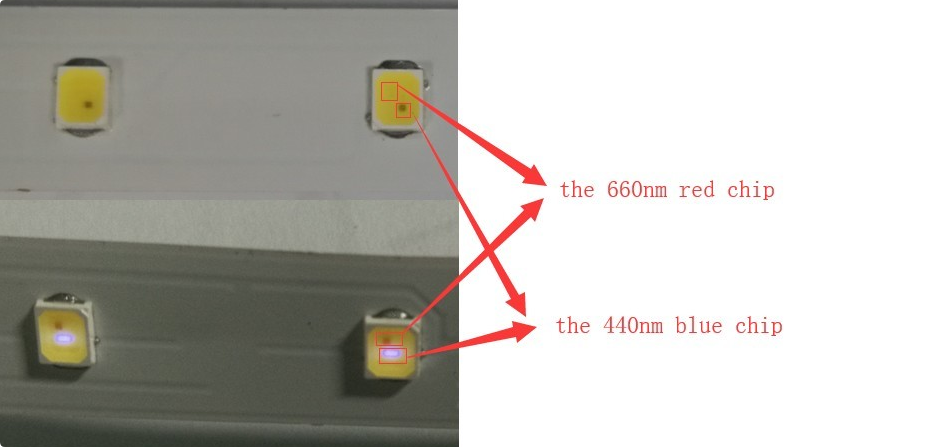
This was more useful than simply calling the product a full spectrum LED grow light strip, because the spectrum graph showed where the output was actually concentrated.
The initial combined-spectrum strip specification was:
Even at this stage, however, we did not treat the specification sheet as the final answer.
The customer wanted to know how different spectra would behave in his own growing setup.
Site Photos Helped Us Understand the Installation Better
After the first discussion, the customer sent us photos of his existing grow room, microgreen trays, current plant lights, the stainless-steel racks he planned to use, and his proposed layout for adding more racks.
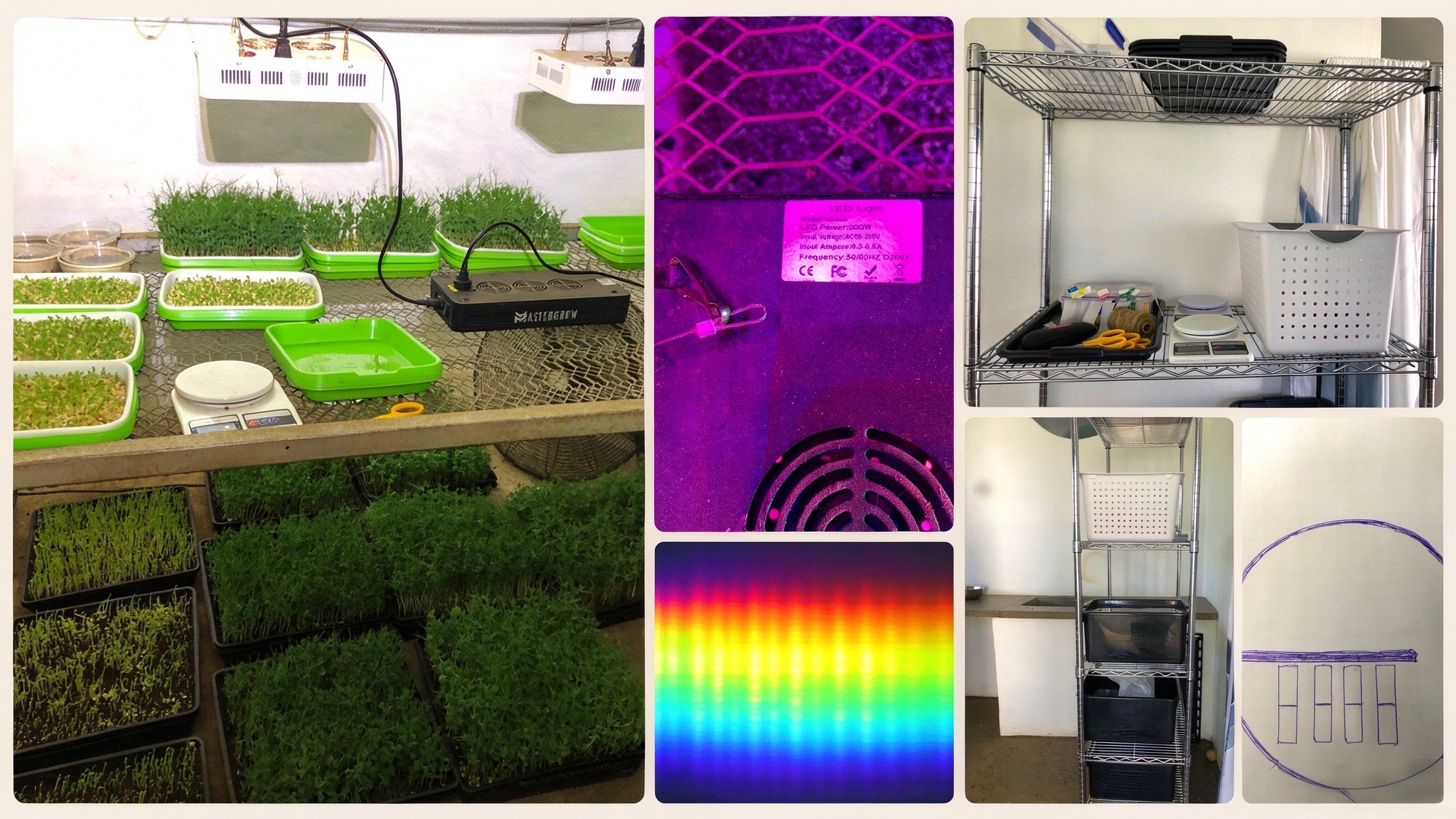
He also asked our engineer to review the setup and suggest how the lighting could be arranged.
These photos made the project much easier to understand.
Each shelf would need its own lighting section, wiring had to be managed between rack levels, and the power supplies had to be positioned in a way that would still work if more racks were added later.
For a multi-level growing system like this, supplying one long roll of LED plant light strips is not enough.
The rack dimensions, shelf spacing, wiring path, and power distribution all affect how the lighting should be configured.
The Plan Changed: From One Spectrum to Three Test Options
While preparing the sample order, we only had about 3 meters of the original combined-spectrum strip available.
At the same time, two other LED strip options were available for testing:
• 5000K High CRI Full Spectrum LED Strip
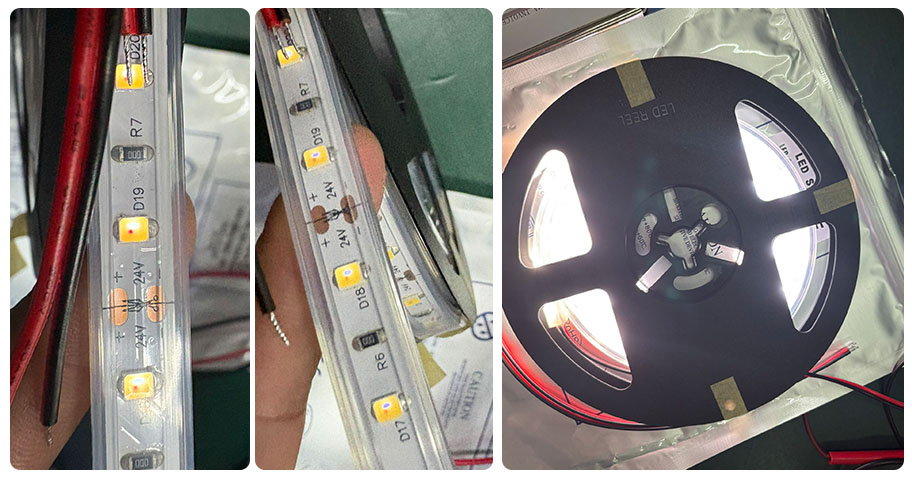
• 660 nm Red LED Strip
Rather than seeing this as a problem, the customer suggested turning it into a comparison.
He wanted to test all three lighting options and observe the differences in his microgreens setup before deciding which direction to use for a larger installation.
In his email, he wrote:
“try and see the difference between growing.”

The test plan was therefore adjusted to:
This gave the customer a way to compare several microgreens grow lights in the same real-world environment rather than choosing only from datasheets.
It is also important to note that spectrum is only one variable.
For microgreens, the amount of light reaching the crop, the photoperiod, and the distance between the LEDs and the plant canopy can all affect the result. Research on microgreens also shows that both light quality and light intensity can influence morphology, biomass, and nutrient-related characteristics.
Installation and Power Supply Planning
1. Using 1-Meter LED Strip Sections for Each Rack Level
The customer wanted the strips cut into approximately 1-meter sections with suitable wiring ends.
This made sense for the rack dimensions and also made the system easier to install on separate shelves.
He initially planned to connect several 1-meter sections in parallel.
A modular approach like this is useful when led strip lights for growing plants are used across multiple rack levels because individual sections can be installed, serviced, or expanded without redesigning the whole rack.
The actual number of sections that can be connected still depends on the strip voltage, watts per meter, wire size, and wiring layout.
2. Matching the Power Supply to the Strip Load
During the early discussion, the customer asked:
“How many meters will one power supply handle?”
At that stage, the high-power combined-spectrum strip was approximately 25 W/m.
Our engineer initially suggested a 150 W power supply for around 5 meters of strip.
The basic load calculation was:
5 m × 25 W/m = 125 W
So the nominal strip load would be 125 W, or about 83% of a 150 W power supply rating.
However, once the test plan changed from one strip type to three different spectrum options, the original single-power-supply idea had to be reconsidered.
3. Three Separate Power Supplies for Three Tests
The customer initially considered using one 150 W power supply for the three different LED strip tests.
After reviewing the setup, our engineer recommended using:
3 × 60 W power supplies
with one power supply assigned to each strip type.
This gave the customer independent control of each test group and made it easier to compare the three lighting options without repeatedly reconnecting different strips.
The final usable strip length for each power supply still depended on the actual voltage and power consumption of the corresponding strip.
A Modular Lighting Configuration for Multi-Level Grow Racks
Based on the rack dimensions, site photos, and expansion plan, the initial grow-rack lighting setup was built around three practical ideas:
• compare several spectrum options before scaling
• use approximately 1-meter LED strip sections to match the rack structure
• power the different test groups independently
The combined-spectrum strip used an IP67 protective structure, which was relevant because grow rooms may involve humidity and occasional water exposure.
However, IP67 on the strip itself does not mean the entire lighting system is waterproof.
Wire exits, connectors, power supplies, sealing methods, heat dissipation, and condensation still need to be considered during installation.
This modular approach allowed the customer to test a small system first and then adjust the lighting configuration before expanding to more racks.
Project Results: From Sample Delivery to Real Microgreens Growing
1. Customer Feedback After Delivery
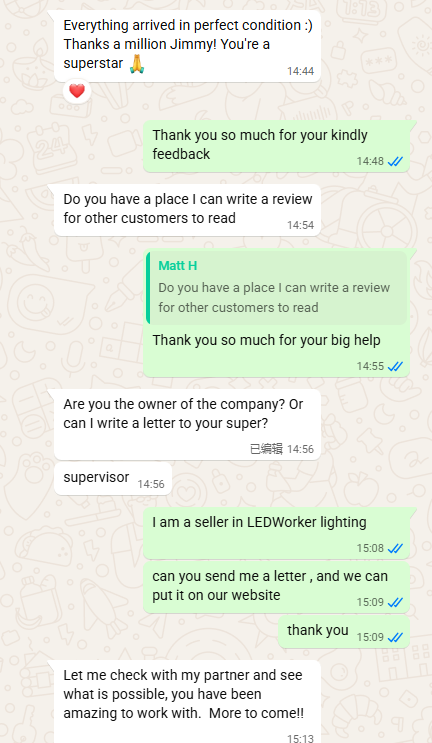
After the shipment arrived in Fiji, the customer sent Jimmy, our sales engineer, a WhatsApp message:
“Everything arrived in perfect condition :) Thanks a million Jimmy! You're a superstar 🙏”
He then asked:
“Do you have a place I can write a review for other customers to read?”
Later in the same conversation, he added:
“You have been amazing to work with. More to come!!”
For us, this feedback was important because it was not only about the products arriving safely.
It also reflected the customer’s experience with the communication and technical support throughout the project.
2. The Lighting Was Put Into Real Grow-Rack Use
In later photos from the customer, multiple metal grow racks can be seen in operation with LED lighting installed under different shelf levels.
The trays show microgreens at different growth stages, and the photos include both white-looking and red-toned lighting environments.
Compared with the original plan to start with a small test system, the customer’s later setup had expanded to multiple racks.
That made the early discussion about modular strip lengths, power distribution, and future expansion especially relevant.

3. Long-Term Use
According to the original project record, the LED strips continued operating in the customer’s growing environment for around two years.
For multi-level grow racks that rely on long daily lighting periods, stable lighting can reduce maintenance and replacement work.
However, we do not have complete comparative crop-performance data from the three spectrum tests, so we do not claim that one of the three lighting options was definitively the best-performing spectrum.
What This Project Taught Us About LED Grow-Rack Lighting
This Fiji project reinforced one practical point:
Choosing a full spectrum grow light strip for a multi-level growing rack should not be based on the product name alone.
The customer originally expected to select one lighting option, but as the rack layout and expansion plan became clearer, it made more sense to compare several spectra and adjust the power configuration first.
For projects where the final lighting recipe is still uncertain, a small test setup can be a practical way to verify spectrum, installation, and power requirements before repeating the same configuration across a larger number of racks.
FAQ
1. Can LED strips be used for growing microgreens?
Yes, but not every decorative LED strip is suitable for plant growth.
For microgreens, the spectrum, PPFD, photoperiod, mounting distance, and crop type should all be considered.
If led plant light strips are being used as the main light source, it is better to review actual horticultural-lighting data rather than rely only on brightness or color temperature.
2. What is the difference between a full spectrum LED grow light strip and a normal LED strip?
A normal LED strip is usually designed for visual or decorative lighting.
A full spectrum LED grow light strip is intended to provide a spectral distribution that is more suitable for plant growth.
The important point is that “full spectrum” is not a single fixed spectrum.
Two products with the same marketing description can still have very different wavelength distributions, so checking the actual spectrum is important.
3. What do 440 nm and 660 nm LEDs do in plant lighting?
440 nm is in the blue region, while 660 nm is in the deep-red region.
Both are commonly used in horticultural lighting.
Blue light is associated with several vegetative and morphological responses, while red light is highly effective for photosynthesis and can influence plant growth and development.
The final effect still depends on crop species, intensity, photoperiod, and the rest of the spectrum.
4. Can different LED grow-light spectra share one power supply?
They can in some cases, provided the strips use the same operating voltage and the combined load remains within the power supply’s safe capacity.
However, for a comparison test like this project, separate power circuits are usually easier to control, maintain, and evaluate.
5. Is an IP67 LED strip suitable for a humid growing environment?
IP67 provides a defined level of dust and water protection for the strip itself, but it does not automatically make the complete installation IP67.
Connectors, cable exits, power supplies, condensation, sealing, and heat dissipation still need to be considered.
Custom LED Grow Light Strips for Your Growing Equipment
If you are developing microgreens racks, vertical-farming equipment, or another indoor growing system, you can send LW Lighting your rack dimensions, spectrum requirements, installation layout, and power conditions.
We can help evaluate suitable full spectrum LED strip grow lights, connectors, wiring options, and power supply configurations, and support sample testing before a larger rollout.
Contact LW Lighting to discuss your LED grow-light-strip project.

Custom RGB LED Strip for U.S. Red Light Therapy Equipment: From Structural Fit to Wiring and Lighting Control
Custom 12V RGB LED strip solution integrated into U.S. red light therapy equipment with tailored lengths, wiring and control.
360° Photo Booth Lighting in Lebanon with TM1934 RGB Pixel LED Strip Case
A real 360° photo booth lighting project in Lebanon using TM1934 RGB pixel LED strips to create programmable colors and dynamic visual effects.
LED Bathroom Mirror Lighting: A Custom COB LED Strip Project in Cyprus
COB LED strip lighting installed behind a custom bathroom mirror for a Cyprus project, creating smooth and even illumination around the mirror.
Recommended News