
"Still Operating Perfectly": A 12V LED Strip Dimmer Project in Australia
By Fiona Huang | Updated:Oct 25, 2026
Most LED strip problems don’t come from the strip itself. They come from what’s wired up around it: the power supply, the dimmer, the profile, the way it’s installed. A great strip with the wrong driver can flicker, buzz, or refuse to dim below 30%. And when that happens on a customer’s site, it’s the installer who gets the phone call.
This is a real project from one of our Australian customers, a small electrician business we’ve worked with since 2020. It started with a simple request to replace old strip lights. It turned into a lesson in choosing a dimmable driver for led strip lights, a good example of how we handle problems when something doesn’t work, and a customer who came back five years later with a very kind message. If you install LED lighting for a living, there’s probably something useful in here for you.
It Started With A Clear Request
In early 2020, Scott sent us his first message. He was replacing an old 5050-type LED strip for one of his customers and wanted to use a good-quality COB strip instead. He needed about 25 metres of 2700K at 12V for the first job. And he added something that told us a lot about him: if the first replacement went well, he expected many more customers to follow.
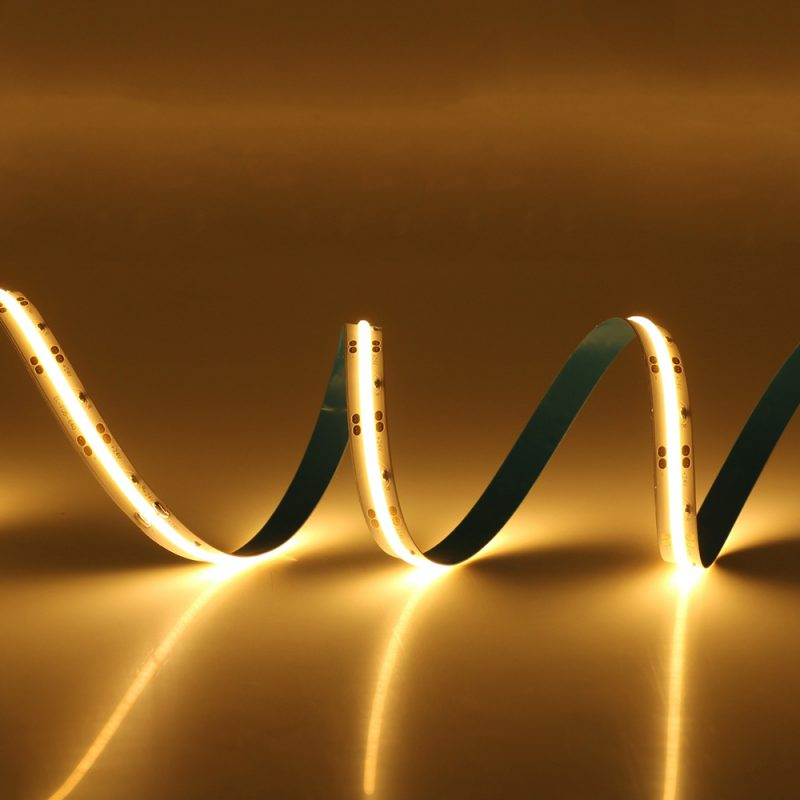
We also talked about colour. A 2700k led tape light gives that cosy, candle-to-incandescent warmth people expect in living rooms, bedrooms, kitchens and restaurants. It’s a good match for someone who’s replacing older warm-looking strips and doesn’t want the room to suddenly feel cold.
The sample order, and the questions that really matter
On 20 May 2020, Scott placed a sample order of around 10 metres: 5 metres of LW-COB010 and 5 metres of LW-COB008, both 2700K, 12V, IP20. Two different models, so he could compare them side by side on his own bench before choosing.
With the order came a few questions:
• Are your COB strips dimmable?
• Do you have a specific driver for them?
• One installation is on a yacht, so it’s 12VDC.
• Another is under stair treads, which needs a driver. He had drivers in stock, but if we had one made for our product, he’d go with that.
Here’s the short answer we gave him. COB strips are constant-voltage products, and yes, they can be dimmed. An adjustable LED light strip setup allows users to control brightness according to different lighting needs. But how you dim them depends on where the power comes from and where you want the dimmer to sit.
Dimming : which dimmable driver do you actually need?
Choosing a led strip dimmable driver isn’t just about wattage. You also need to decide where the dimming happens. Here are the common options:
• Mains-side dimming (Triac / phase-cut). The driver is a Triac dimmable power supply. It takes the cut waveform from a wall dimmer and converts it into a dimmed 12V or 24V output. This is popular in homes because the installer can reuse a normal wall dimmer. It’s also where most compatibility problems show up, because wall dimmers and drivers come in different types (leading edge, trailing edge) and they don’t always get along.
• DC-side dimming (PWM dimmer). You use a standard non-dimmable 12V or 24V driver, then put a PWM dimmer between the driver and the strip. This is simple, stable, and the best fit for 12VDC systems, such as a yacht, a caravan or a battery supply, where there’s no mains at all.
• 0-10V / 1-10V or DALI. Common in commercial projects with a central control system. These need a driver that supports the same protocol.
• Wireless controls. Push-dim, RF remotes, or app control. Convenient for retrofits where running new control cables is a hassle.
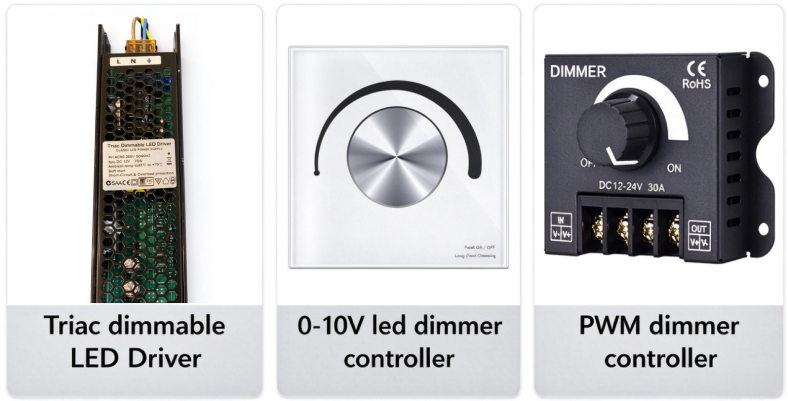
For Scott’s two jobs, that meant two different answers. The yacht was 12VDC, so a DC-side PWM dimmer was the natural choice. When selecting an LED strip dimmer 12V system, it's important to match the dimmer with the power source and LED strip requirements. The stair treads needed a proper mains driver, installed somewhere accessible, with the strip run kept short enough to avoid voltage drop.
Here are a few practical tips we shared with him, which may also help with your installation:
• Don’t load a driver to 100%. Leave around 20% headroom. A 60W driver is happy running about 48W of strip.
• Check the dimmer’s minimum load. Many wall dimmers were designed for incandescent bulbs and need a minimum load to work properly. A short run of LED strip may be well below that, which causes flicker or a dimmer that won’t go low.
• Match the dimming type. A Triac dimmable driver needs a compatible Triac wall dimmer. A 0-10V driver needs a 0-10V controller. Mixing them is the most common cause of trouble.
• Keep 12V runs short. Low voltage means higher current, and the strip gets dimmer at the far end if the run is too long.
Scott was happy with the answers. After the samples arrived, he told us the quality was good. That was step one.

Choosing flexible COB LED Strips for a Hotel: What a Lighting Consultant Looks At
A Qatar hotel project shows how COB LED strip samples, IP ratings and matching power supplies support selection, site approval and long-term supply.

Full Spectrum LED Grow Light Strip Project for Microgreens in Fiji: From Small-Scale Testing to a Scalable Grow Rack Lighting Setup
A Fiji microgreens grow rack project using full spectrum LED grow light strips, with spectrum testing, modular installation and scalable power planning.

Custom RGB LED Strip for U.S. Red Light Therapy Equipment: From Structural Fit to Wiring and Lighting Control
Custom 12V RGB LED strip solution integrated into U.S. red light therapy equipment with tailored lengths, wiring and control.
Recommended News