
60 lm/W vs. 100 lm/W: What Is the Technical Reality Behind Cut-Free COB LED Strip Lights?
By Libby Chen | Updated:Oct 18, 2026
When competitors offer higher luminous efficacy at a lower price, how do we determine whether this represents genuine technological progress or simply a more attractive set of specifications?
LED Strip Lighting Insights | A manufacturer’s perspective on the technical considerations behind LED strip design, customisation, and real-world applications.
A Customer’s Comment That Got Me Thinking
Recently, a long-standing customer we have worked with for years sent me a message:
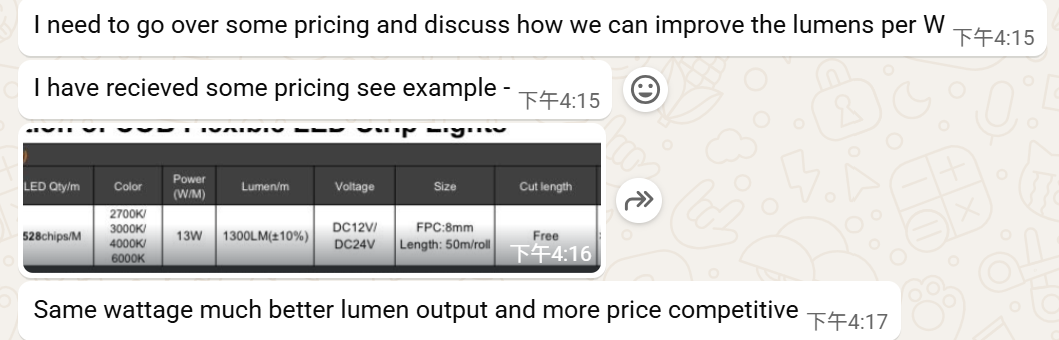
“Same wattage, much better lumen output and more price competitive.”
The competitor’s product quotation showed a Cut-Free COB LED strip with 528 chips/m, a 24V operating voltage, an 8mm-wide PCB, a power consumption of 13W/m, and a luminous flux of 1,300 lm/m (±10%). Based on these figures, the stated luminous efficacy is approximately 100 lm/W.
More importantly, the competitor’s price was also more competitive than ours.
By comparison, the Cut-Free COB LED strip we currently supply to this customer has an actual tested luminous efficacy of only 64.12 lm/W.
Looking at these two figures alone, the competitor’s product certainly appears very attractive.
As a supplier, I completely understand why the customer raised this concern.
If I were the buyer and found a similar product that offered both a lower price and significantly higher luminous efficacy, I would certainly take a closer look at it, too.
However, when I saw the quotation, my first reaction was scepticism.
Because I understand the circuit design of our products, I also know that achieving true cut-free functionality requires certain trade-offs in the circuit design of COB LED strips.
Is 100 lm/W really achievable?
But soon, I realised something important:
Scepticism is not evidence, and experience is no substitute for testing.
If our competitors have genuinely achieved higher luminous efficacy through technological innovation, that is certainly something worth learning from.
If the two products differ in CRI, CCT, test conditions, or circuit design, however, luminous efficacy figures alone are not enough to determine which product is better.
And if certain specifications have not been verified through actual testing but are still being promoted as key selling points, what impact could that have on customers and the market as a whole?
I don’t want to simply tell our customer, “Our figures are accurate.”
I want to understand the underlying reasons:
Why does our Cut-Free COB LED strip achieve only 64.12 lm/W? Why can other suppliers claim 100 lm/W? What technical differences account for such a significant gap?
More importantly, can we genuinely improve our products, rather than simply make the figures on our datasheets look more impressive?
With these questions in mind, I decided to revisit the fundamentals of LED series and parallel circuit configurations and analyse the issue from the ground up.
64.12 lm/W: What Do the Actual Test Results Tell Us?
The Cut-Free COB LED strip we currently supply operates at 24V and features an 8mm-wide PCB, 528 chips per metre, and a correlated colour temperature (CCT) of 3000K.
To verify its actual performance, we tested the product using an EVERFINE spectroradiometric testing system.
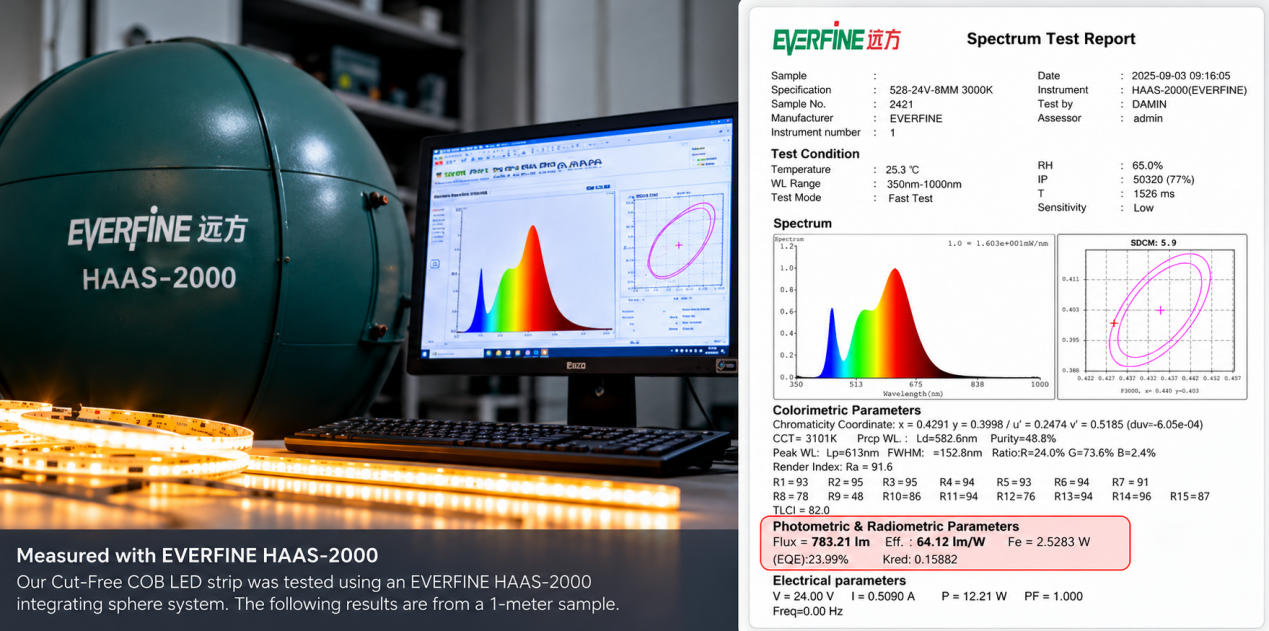
The following are the actual test results for a 1-metre sample:
Based on the luminous flux and input power recorded in the report, we can calculate the luminous efficacy as follows:
Luminous efficacy = Luminous flux ÷ Input power
783.21 lm ÷ 12.21 W ≈ 64.15 lm/W
783.21 lm ÷ 12.21 W ≈ 64.15 lm/W
This is broadly consistent with the reported value of 64.12 lm/W. The small discrepancy is due to rounding in the displayed test data.
It is not an impressive figure, particularly when compared with the competitor’s quoted 100 lm/W. The gap is significant.
However, this is the result we obtained from actual testing.
There is another detail worth noting: our product achieved a measured CRI (Ra) of 91.6, making it a high-CRI product.
In general, under otherwise comparable conditions, LED products with a CRI of 90 can be more challenging to optimise for high luminous efficacy than those with a CRI of 80. Improving colour rendering may involve a trade-off with luminous efficacy.
Similarly, warm white light at 3000K may have a different luminous efficacy from neutral white light at 4000K.
Therefore, when comparing two LED strip products, we should look beyond lm/W alone. We also need to verify the CRI, CCT, actual power consumption, and test conditions, including differences between testing equipment and measurement systems.
That said, I do not want to use these factors to avoid the issue.
Even after accounting for differences in CRI and CCT, the gap between 64.12 lm/W and 100 lm/W remains substantial and deserves serious investigation.
Reliable test data should do more than demonstrate that our specifications are not overstated. It should provide the starting point for genuine product improvement.
How Long Do LED Light Strips Last? Understanding the 50,000-Hour Rating, Early Failure Causes, and How to Extend Lifespan
How long do LED strips last in real-world use? Learn what the 50,000-hour rating really means, what affects LED strip lifespan, and how to help your lighting last longer.

ES32 PIR Sensor Stair Light Controller: Smarter, Smoother and More Efficient Stair Lighting
See how the ES32 stair light controller uses PIR motion sensors and LED strips to create smooth, automatic lighting for modern staircases.

WT5 5-in-1 LED Controller Installation Guide: One Controller for Multiple LED Strip Types
Need one controller for different LED strips? See how the WT5 makes installation and expansion easier.
Recommended News