
ErP Compliance vs. Cost: Why Are High-Efficiency COB LED Strips So Challenging?
By Libby Chen | Updated: Nov 24, 2026
A Manufacturer's Perspective on LED Efficiency, Technical Limitations, and Finding the Right Balance.
A customer recently approached us with a request:
"We need a COB LED strip that meets ErP requirements, but the price must remain competitive."
Sounds reasonable, right?
After all, COB LED strips are already widely used in architectural, residential, and commercial applications. They offer smooth, continuous illumination without visible LED dots.
So why should achieving higher efficiency be so difficult?
Here's something interesting from our own product development experience:
Our high-efficiency SMD LED strips can achieve 180 lm/W, even up to 210 lm/W under specific conditions.
Our current COB LED strip range reaches approximately 140 lm/W at its highest.
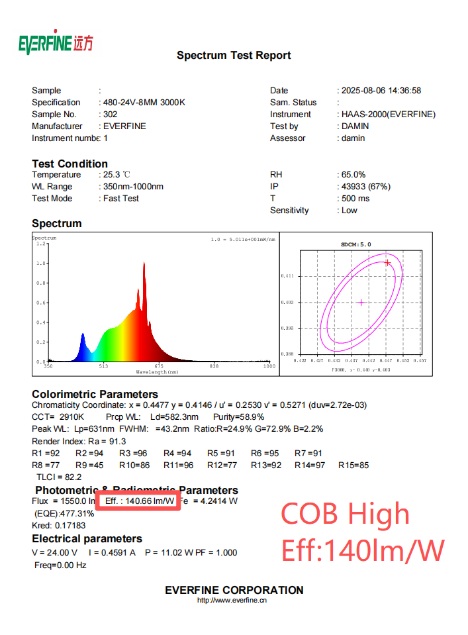
That's a significant difference.
Why does it exist?
Could we simply increase the current to make COB brighter?
Could better LED chips or phosphor materials solve the problem?
And most importantly, how can we improve efficiency without pushing the product price beyond what customers can accept?
This is where LED strip development becomes more than just an engineering challenge.
It's about finding the right balance between efficiency, compliance, performance, and cost.
Let's explore what's happening behind the technology.
What Are the ErP Requirements for LED Strip Lights?
Why are more European customers asking for higher LED efficiency?
In recent years, we've noticed a growing number of European customers paying closer attention to LED efficiency.
Previously, many product discussions focused mainly on brightness, colour temperature, CRI, lifespan, and price.
Today, energy efficiency has become another important consideration.
LED luminous efficacy is measured in lumens per watt (lm/W). It tells us how much visible light a product produces for each watt of electrical power consumed.
Let's look at a simple example.
Imagine four LED strips, each consuming 6W per metre.
| Luminous efficacy | Light output |
|---|---|
| 100 lm/W | 600 lm/m |
| 140 lm/W | 840 lm/m |
| 180 lm/W | 1,080 lm/m |
| 210 lm/W | 1,260 lm/m |
At the same power consumption, higher efficacy means more light output.
Alternatively, a more efficient LED strip can often deliver the required brightness using less power.
But there's an important distinction.
ErP compliance and EU energy efficiency classes are not exactly the same thing.
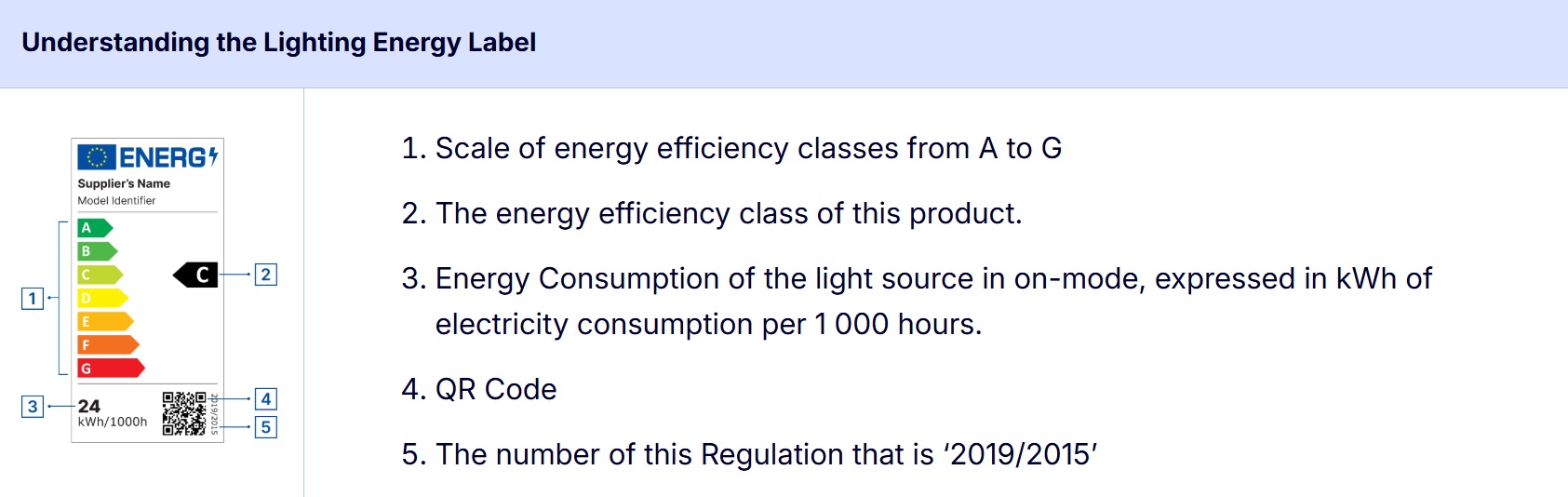
EU Regulation 2019/2020 establishes eco-design requirements for applicable light sources, while Regulation 2019/2015 covers energy labelling and the A–G efficiency classification.
The applicable requirements depend on the product's characteristics and regulatory classification.
Therefore, there isn't one universal lm/W value that automatically guarantees ErP compliance for every LED strip.
Before developing a product, we need to understand the customer's actual compliance requirements and target efficiency class.
Once we know the target, we can begin working towards it.
But when the customer specifically requests COB technology, another challenge appears.
Why is achieving high efficiency with COB generally more difficult than with SMD?
Recommended News