
COB vs SMD LED Strip: Differences, Pros, Cons and How to Choose
By Sunny Zhang | Updated: Sep 8, 2026
COB and SMD are often compared when people are choosing LED strip lights. But for buyers and lighting designers, the real questions are usually more practical: What is the actual difference between COB and SMD LED strips? And is cob vs smd which is better?
The answer starts with how the two types of LED strips are built.
From the way the LED chips are packaged to how they are mounted on a flexible PCB, COB and SMD follow different manufacturing processes. Those differences eventually show up in the finished product—in light appearance, available specifications, cost, installation requirements and where the strip works best.


COB VS SMD LED Strip
For a buyer, lighting designer or project contractor, it is more useful to understand these differences than to simply ask which technology is newer.
So, rather than treating COB vs SMD LED strip as a simple winner-and-loser comparison, let's look at how both are made, what they do well, where they fall short, and how we choose between them for real lighting projects.
COB vs SMD LED Strip: The Structural Difference
SMD LED Strip: Packaged LEDs Mounted on the PCB
SMD stands for Surface Mounted Device.
In an SMD LED strip, each LED is packaged as an individual component first. These finished LED packages are then mounted and soldered onto a flexible PCB using an SMT production line.
Common SMD packages include SMD2835, SMD3528, SMD5050, SMD2216 and SMD5630. Each package has its own characteristics in terms of size, output, power and application.

Because the LEDs are separate components, there is normally some space between one LED and the next. If the strip is installed close to a diffuser—or used without one—you may be able to see the individual points of light.
Depending on the design, common SMD LED strips may use 30, 60, 90, 120 or 240 LEDs per meter.
SMD has been used in LED strip manufacturing for many years, so the product range is extremely mature. Buyers can choose from a wide combination of power levels, color temperatures, CRI values, voltages, IP ratings, LED densities and control options.
COB LED Strip: LED Chips Mounted Directly on the PCB
COB stands for Chip on Board.
Instead of mounting individually packaged LEDs onto the PCB, a COB led light strip places a large number of small LED chips directly onto the circuit board. The chips are then covered by a continuous phosphor encapsulation layer.
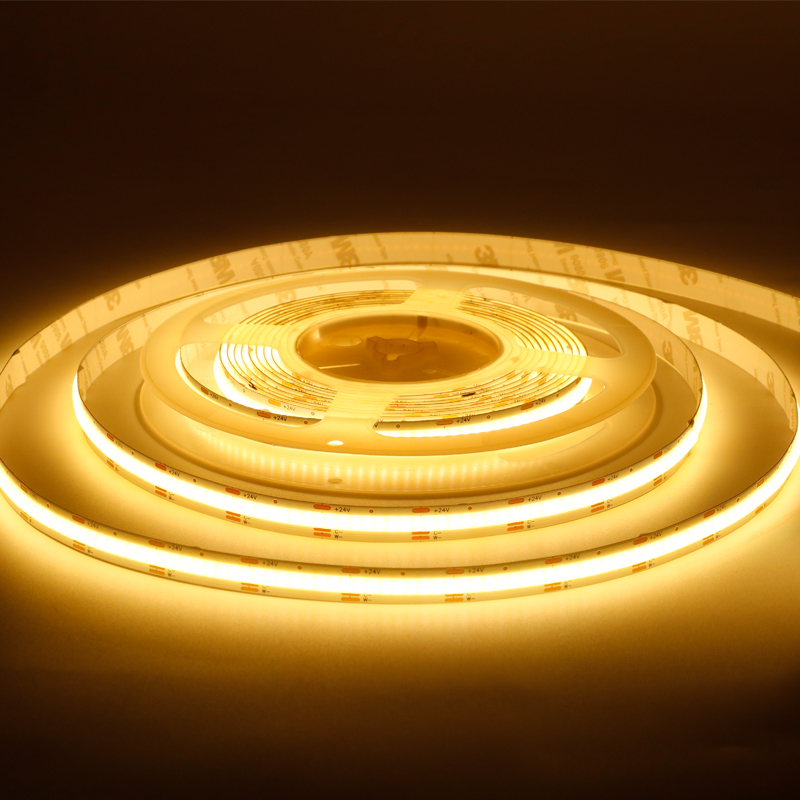

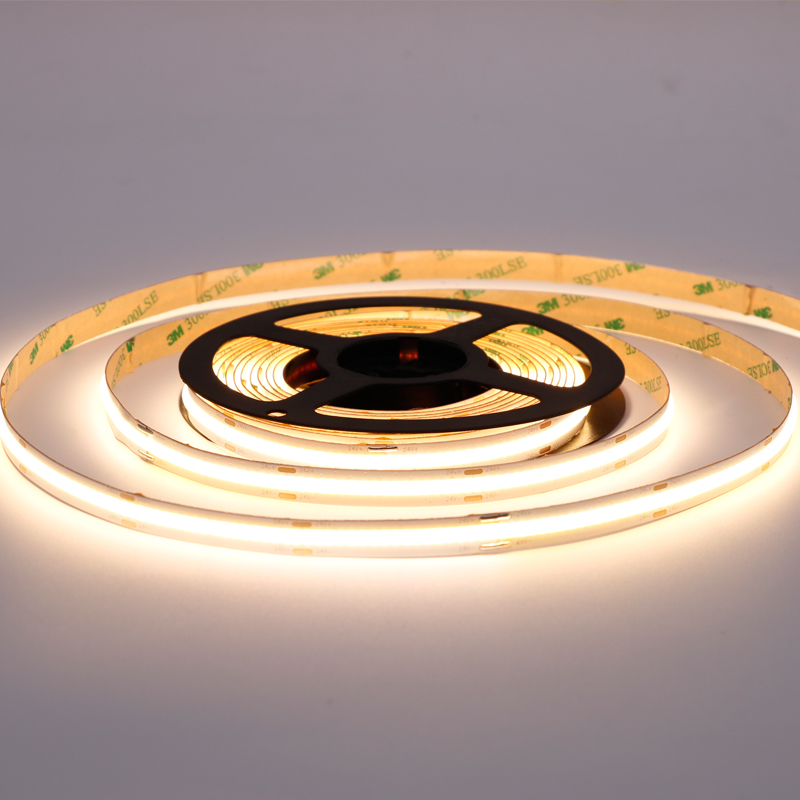

In simple terms:
SMD: Packaged LED + PCB
COB: Flip‑chip LEDs + PCB + continuous phosphor encapsulation
This construction allows many more light‑emitting points to fit into a relatively small area. Common COB designs may have 320, 480 or 576 chips per meter, although other densities are also available.
Because the chips sit close together under a continuous encapsulation layer, the light looks more like one uninterrupted line instead of a row of separate LEDs.
That is one of the main reasons COB LED strip lights have become popular for applications where the strip itself is close to the visible surface.
Newer packaging approaches such as SCOB LED Strip are also appearing. These designs use different chip arrangements and packaging structures to push COB‑style products into more output, efficiency and specification ranges.

FREE Custom LED Strip Development — Turn Your Market Insight into Products
Turn your market insight into custom LED strip products, with free PCB design, neon tooling and packaging design for qualifying projects.

How to Choose LED Strip Lights for Renovation Projects: A Guide for Ceilings, Cabinets and Stairs
A practical guide to choosing LED strip lights for renovation projects, covering ceiling coves, kitchen cabinets, display shelves, stairs, power and control.
Why LED Strip Lighting Connectors Matter: Compatibility, Connection Methods and Project Reliability
Explore LED strip lighting connectors for COB and SMD projects. Compare solderless connections with soldering, check compatibility, and choose the right fit.
Recommended News