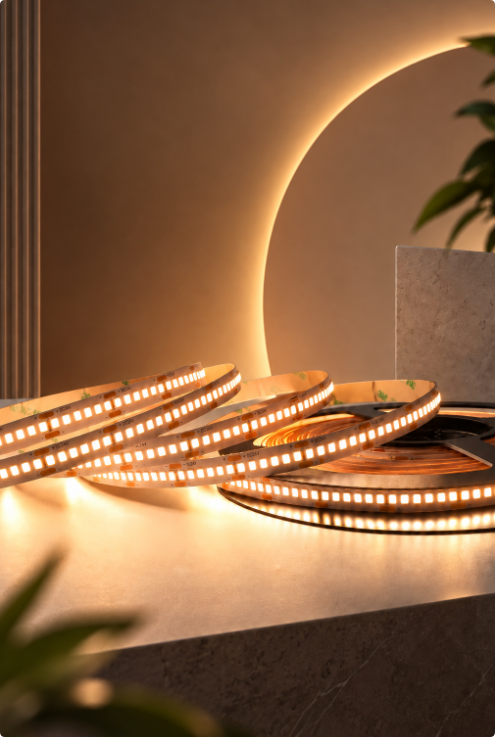
When choosing LED lighting, CRI (Color Rendering Index) is a crucial yet often overlooked parameter. It measures how accurately a light source reveals the true colors of objects compared to natural light, directly affecting visual quality and overall experience.
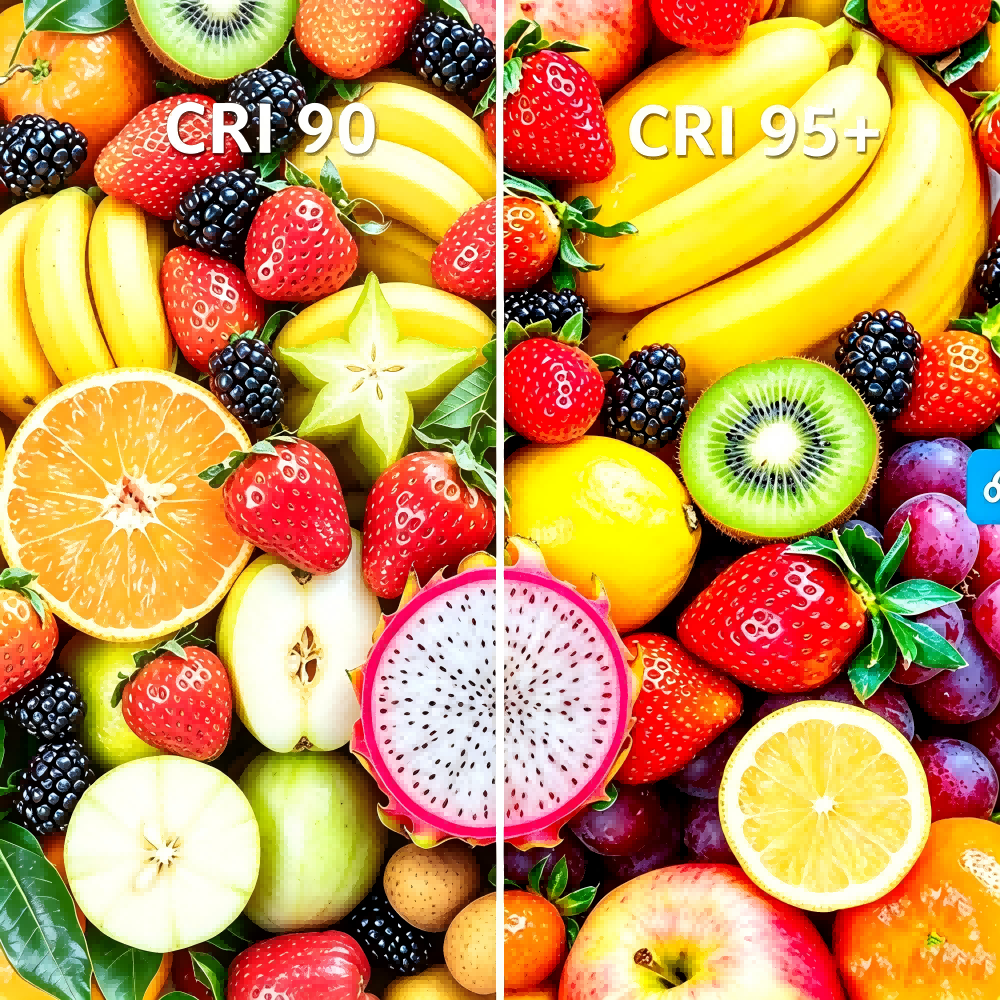
    led strip light cri 95


What Is CRI (Color Rendering Index)?

CRI, short for Color Rendering Index, measures how accurately a light source renders the colors of objects it illuminates. Simply put, it indicates whether the light can faithfully reproduce the true colors of objects.
CRI Range: 0–100
Standard: Defined by the CIE (International Commission on Illumination), using sunlight as the reference standard.
Significance: The higher the CRI, the better the light source is at rendering colors. Ideally, a light source that mimics natural sunlight has a CRI of 100.


How Is the CRI Value Determined?

CRI is measured by evaluating how a light source renders a set of standard color samples. Multiple Ri values are obtained and then averaged.
Ra: The most commonly referenced CRI value, calculated as the average of R1–R8 color samples.
R9: A very important but often unlisted value in the CRI specification, specifically measuring the light source’s ability to render red tones.
R9 is critical in many professional applications, such as film and TV lighting, medical lighting, and art illumination, where accurate red reproduction is essential.
Since R9 is not included in the standard Ra calculation, it is usually presented as a supplementary metric.
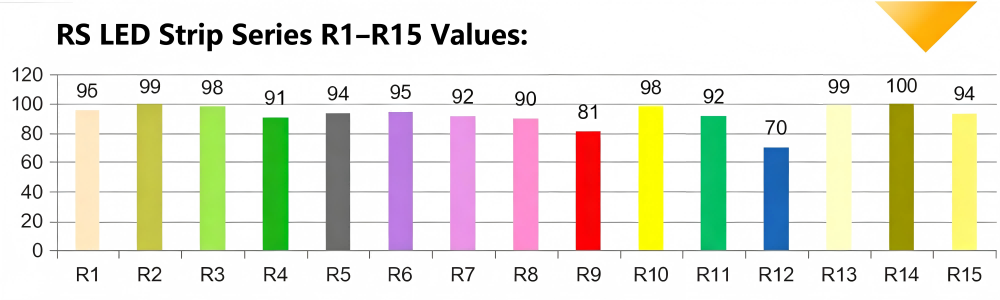
high cri led tape


The Role of CRI in Daily Life

High-CRI lighting significantly enhances color accuracy, making colors appear more true-to-life and vibrant. This is especially important for commercial lighting, display lighting, and professional applications.
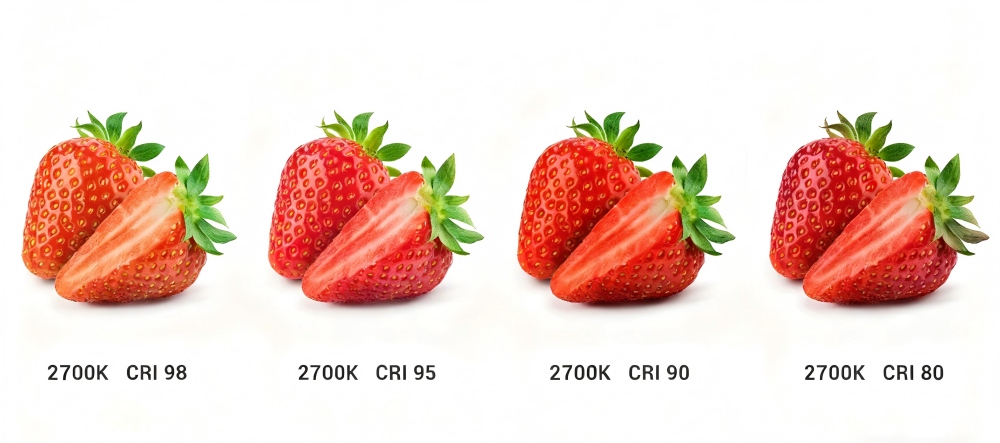
98 cri led strip

 
For example:
Standard commercial LED strips: Typically led strip light cri 95. Many supermarkets now use this standard to make product colors appear more natural and vivid, improving the shopping experience.
Specialized equipment lighting:Requires higher CRI values. 98 cri led strip are used in fields demanding precise color accuracy, such as high-end retail displays, color evaluation instruments, and medical lighting.
Photography and film lighting:Not only requires high CRI but also an R9 value of 98 to ensure accurate red reproduction, achieving optimal imaging results.
This is why different applications have varying CRI requirements—it’s not just about brightness, but also about color performance.
CRI, Brightness, and Cost: How to Find the Right Balance

With the development of LED technology, CRI 90 has become the market standard, and the price difference compared to CRI 80 is now minimal. However, when moving to CRI 95 and above, the cost still increases noticeably.
When selecting high cri led tape, it’s important to consider application, brightness requirements, and budget together.
1.Applications and Performance by CRI Level
CRI 80 led strip
Applications: Warehouses, industrial lighting, basic functional lighting
Brightness: Higher luminous efficiency (more lumens per watt)
Cost: Most cost-effective
Features: Suitable for general lighting where color accuracy is not critical
CRI 80 led strip 
90 CRI led strip
Applications: Residential, commercial spaces, offices, hotels
Brightness: Good balance between brightness and color rendering
Cost: Competitive and widely available
Features: Natural color appearance, ideal for most indoor environments
90 CRI led strip 
CRI 95+
Applications: Art galleries, retail displays, exhibitions, jewelry lighting
Brightness: Slightly lower under the same power conditions
Cost: Higher
Features: Excellent color accuracy, especially for reds (R9), making colors appear more vivid and true to life
CRI Level Ra Value R9 Value Typical LM/W Brightness Price Level Typical Applications
CRI 80 ≥80 < 0 / low 110–130 Highest Low Warehouse, industrial lighting
CRI 90 ≥90 10–30 90–110 Balanced Medium Residential, office, commercial
CRI 95 ≥95 >65 70–90 Lower High Retail, gallery, display lighting
2. Why Does Higher CRI Increase Cost?
In LED design, improving CRI usually comes with a trade-off in luminous efficiency.
👉 Higher CRI often means lower brightness at the same power level
To maintain the required brightness, manufacturers need to:
Use higher-output LED chips; Apply more advanced and efficient phosphor materials; Optimize the overall optical designThese improvements lead to higher material and production costs.
3.  Average CRI 95 vs True CRI 95
Not all CRI 95 LED strips perform the same:
Average CRI 95: The cri 95 led strip overall CRI reaches 95, but key values like R9 may be lower; True CRI 95 (Full Spectrum): Both the average CRI and critical values such as R9 are high, ensuring superior color accuracy.
👉 For professional applications, R9 performance is often more important than the average CRI value.
4. How to Choose the Right CRI?
Instead of simply choosing the highest CRI available, consider:
Your application requirements; The level of color accuracy needed; Brightness expectations; Budget constraints.
👉 The right balance always delivers the best value.
👉 Not sure whether CRI 80, 90, or 95 is right for your project?
Contact us today—we’ll help you find the best balance between color quality, brightness, and cost for your specific application.
CRI98 LED STRIP TEST


Is Higher CRI Always Better?

The answer is no.
While a higher Color Rendering Index (CRI) provides more accurate color reproduction—closer to natural daylight—it does not mean that every application requires high CRI lighting.
Firstly, higher CRI usually comes with higher cost. This is because improving CRI often involves a trade-off with luminous efficiency (brightness). To maintain the same brightness level, higher-quality LED chips and better phosphor materials are required, which increases the overall cost.
Secondly, not all applications require high CRI LED strips:
CRI 80: Suitable for general lighting such as warehouses and industrial environments, offering excellent cost efficiency
CRI 90: Provides a good balance between brightness and color accuracy, ideal for residential and commercial lighting
CRI 95+: Used in applications where color precision is critical, such as art galleries, retail displays, exhibitions, and jewelry lighting
Therefore, choosing the right CRI should be based on your specific project requirements, rather than simply selecting the highest value available.
 
  cri95 led strip jewelry lighting
                                                                                                                                 Jewelry Lighting

 
👉 Not sure which CRI is right for your project? Contact us today for expert advice and tailored LED strip solutions that balance performance and cost.

FAQ

1. What is CRI in lighting?
CRI (Color Rendering Index) measures a light source's ability to display colors accurately. The scale ranges from 0 to 100, with 100 representing the color quality of natural daylight. LED strips with higher CRI ratings allow colors, textures, and skin tones to appear more natural, making them ideal for architectural, retail, hospitality, and residential lighting projects.
2. What CRI is best for LED strip lighting?
It depends on the application. CRI 80 is suitable for basic lighting, CRI 90 is ideal for most residential and commercial uses, while CRI 95+ is recommended for high-end applications like retail displays, galleries, and jewelry lighting.
3. CRI 80 vs 90 vs 95: what’s the difference?
The main difference lies in how accurately each light source reproduces colors compared to natural sunlight. The higher the CRI, the closer the light is to natural daylight, resulting in more realistic and vivid colors.
CRI 80 provides basic color rendering and is suitable for general lighting
CRI 90 offers more natural and comfortable color appearance for most indoor applications
CRI 95 delivers highly accurate color reproduction, especially for reds and skin tones, making it ideal for high-end lighting applications
In short, higher CRI means better color fidelity—but the right choice depends on your specific application.
4. Is higher CRI always better?
No. While higher CRI improves color accuracy, it also increases cost and may reduce brightness efficiency. The best choice depends on your specific lighting requirements.
5. Does higher CRI mean brighter?
No. In most cases, higher CRI actually reduces luminous efficiency (LM/W), meaning the light may appear less bright at the same power level. To maintain the same brightness, higher-quality chips and more advanced phosphor materials are often needed, increasing the cost. In short, the best choice depends on whether your project prioritizes brightness or color accuracy.
6. What is R9 and why does it matter?
R9 measures how well a light source renders red colors, which are not included in the general CRI (Ra) average. A higher R9 value is essential for applications where accurate color reproduction is critical, such as retail, food display, and skin tone lighting.
Residential LED Strip
CRI90 for daily home decoration lighting
Commercial LED Strip
CRI95 for supermarket & retail display
Industrial LED Strip
Cost-effective CRI80 for warehouse usage

Not Sure Which CRI to Choose?

There is no “one-size-fits-all” CRI. The right choice depends on your project’s needs for color accuracy, brightness, and budget.
If you’re unsure whether to choose CRI 80, 90, or 95—or how important R9 is for your application—our team is here to help. We’ll recommend the most suitable LED strip solution based on your specific project.
💬 Get in touch → Contact us today
📧 Or email us at: sales@ledworker.com
How to Upgrade Traditional LED Lighting with S1-B(WT) WiFi Triac Dimmer Controller
Bring smart control to existing Triac dimmable LED strips without replacing fixtures or drivers. The S1-B(WT) delivers smooth, flicker-free dimming with app, RF remote, push switch, and voice control in one compact solution.
Unified Power Supply Solutions for Multiple LED Strips/ How to Power Multiple LED Strips with One Solution
Learn how to connect multiple LED strip lights to one power supply. Discover wiring methods, power calculations, voltage drop solutions, and installation tips.
Why More Architects Are Integrating LED Lighting Into Slat Wall
Black neon slat wall LED lighting hides into wood slats, giving a dimmable, dot-free glow and bringing a warm touch to modern homes and hospitality interiors.

Recommended News